You Don’t Lack Discipline. Your Gym Is Just Too Far Away.

A marketing company tracked 7.5 million phones at American gyms for a month. What separated the people who showed up from the people who did not had nothing to do with willpower.

By the end of this you will be able to work out, almost to the minute, what your gym membership actually costs you each week. It is not the figure on your bank statement, and it is the reason the membership stopped getting used.
The Number Nobody Mentions When You Sign Up
In 2017 an advertising firm called Dstillery published something no gym chain would have released about itself. The company looked at anonymised location data from 7.5 million mobile devices that had visited gyms across the United States over roughly four weeks, then asked a single question: how far do these people live from the gym they pay for?
The answer sorted almost cleanly by how often they turned up.
One point four miles. That is the whole gap between a gym you use and a gym you quietly fund.
It is a strange number to sit with, because nobody has ever blamed 1.4 miles for anything. When a membership goes unused, the explanation people reach for is about character. They say they got lazy. They say they lost motivation. Almost nobody says the drive got long enough that the math stopped working.
What this study is, and what it is not
Dstillery sells advertising, not research. This analysis was never peer reviewed, and it shows a pattern rather than a cause: people who are already committed may simply choose closer gyms in the first place. Treat it as a very large clue, not a law. The company’s own write-up of it has since gone offline, so the figures above are cited from the coverage that survives.
The clue does hold up where researchers have looked at it properly. A 2022 systematic review in Systematic Reviews pooled 23 studies covering 5,785 older adults who had been prescribed exercise for a medical or surgical reason. Among the things that predicted whether they actually completed the sessions, distance from the exercise facility came out as a negative predictor, on moderate quality evidence. Depression was the other one.
A separate 2022 paper in BMC Public Health took 7,358 Swedish adults and measured the real distance from both their home and their workplace to every kind of physical activity facility nearby. Longer distances to paid indoor and outdoor facilities went with a lower frequency of exercise. The effect per unit of distance was small, and the authors are careful to say the design is cross sectional and that bigger, longer studies are needed. Their conclusion still points the same direction as everything else here.
So the pattern shows up in ad-tech data, in a clinical review, and in a national survey. Three very different ways of looking, one answer.
Your One-Hour Workout Is A Two-Hour Workout
Here is where the miles turn into something you can feel. Almost nobody spends one hour on a one-hour gym session. The hour is the part you remember, and it is surrounded by a much larger block of time that never gets counted.
Below is that block, built on the median 3.7 mile trip from the study above. Every assumption is written down so you can argue with it and swap in your own.
| Step | Minutes |
|---|---|
| Drive there, 3.7 miles through lights and traffic | 12 |
| Park and walk in | 4 |
| Change | 6 |
| Wait for a rack, a bench or a machine | 10 |
| The workout itself | 60 |
| Shower and change back | 12 |
| Walk out, drive home | 14 |
| Door to door | 118 |
This is our estimate, not a measurement. It is a model built from the median distance in the Dstillery data plus ordinary assumptions about parking, changing and waiting. Your gym may be quicker. If it is busy at six in the evening, it is slower.
Fifty eight of those minutes are not training. They are the price of admission, and you pay it every single session, forever. Train three times a week and that overhead runs to roughly 151 hours a year. Six and a quarter full days, gone into a car park and a changing room.
Motivation rarely fails during the workout. It fails in the car, about four minutes in, when the day has already been long.

This is the part the discipline story gets wrong. The choice to skip is almost never made in front of a barbell. It gets made on a sofa at 6:10pm, when the honest question is not “do I want to train” but “do I want to spend the next two hours of my evening on this”. Those are completely different questions, and only one of them is about wanting it enough.
The Twenty-Two Minutes Before Your First Rep
Chemists have a term for the energy you have to put in before a reaction will run on its own. It is called activation energy, and it is a useful way to think about why some habits stick and others never catch.
Using the same table, a gym session asks for about 22 minutes of pure setup before you touch a weight. Drive, park, change. That is before you have queued for anything. Equipment sitting in your hallway asks for zero. You are mid-set before the part of your brain that negotiates has finished opening its mouth.
Twenty two minutes does not sound like a barrier. On a good day it is not one. The trouble is that a habit does not get tested on good days. It gets tested on the evening you are tired, the morning it is raining, the week work runs late three days running. On those days a 22 minute toll is the whole ballgame, and a zero minute toll is why the set still happens.
Ten Minutes Counts For More Than You Think
Training at home unlocks something a commercial gym physically cannot sell you, no matter how good it is: the very short session. Nobody drives 3.7 miles for ten minutes of work. If the gear is already in the room, ten minutes is free.
Researchers call these exercise snacks, and the term is not a euphemism. It comes out of a real line of work.
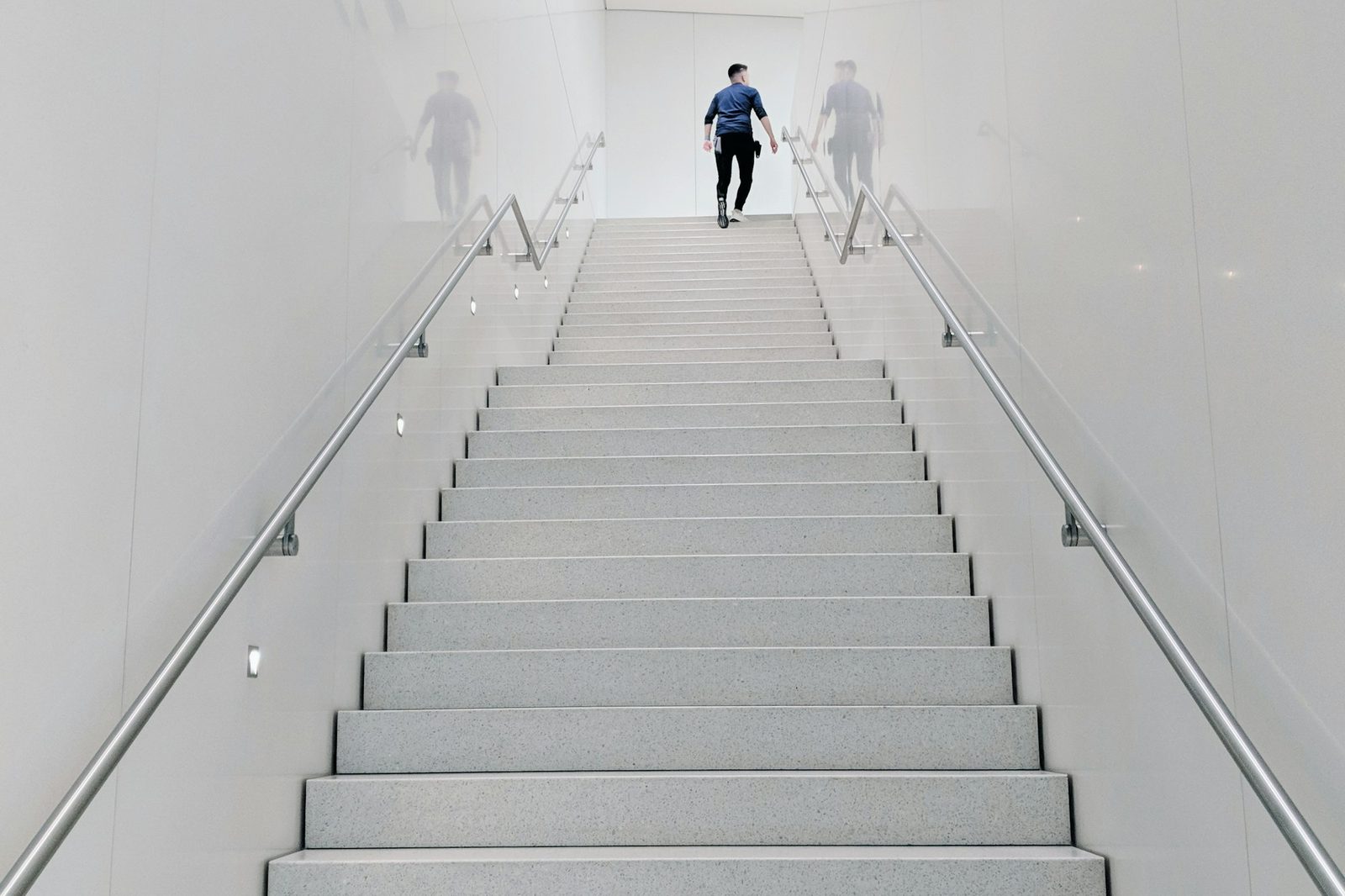
In a 2019 study out of McMaster University, sedentary young adults climbed a three flight stairwell, 60 steps, vigorously, three times a day with one to four hours between efforts. They did this three days a week for six weeks. Compared with a control group that did nothing, their peak oxygen uptake improved. The authors are direct about the size of it: the increase was modest, and there were only 12 people in each group. It is a small study, and it should be read as one.
The larger evidence is observational. A 2022 paper in Nature Medicine followed 25,241 adults in the UK Biobank who did no formal exercise at all, using wrist trackers to catch brief bursts of hard everyday movement. Over about seven years, participants averaging just 4.4 minutes a day of those bursts showed substantially lower rates of death from all causes, from cancer and from cardiovascular disease than those with none. That study can show association only. It cannot prove the movement caused the difference, and nothing here is medical advice or a claim that ten minutes treats or prevents any condition.
What both point at is modest and useful: short, hard, scattered effort is not wasted effort. And short scattered effort is the one format a gym 3.7 miles away can never offer you.
- Ten minutes with a pair of loaded handles while the coffee brews.
- A weighted walk on the school run, which costs no extra time at all.
- Three sets between meetings, in the clothes you are already wearing.
None of that is a replacement for a serious training block if you want one. It is what fills the four days a week when the serious block was never going to happen anyway.
“But A Home Gym Costs Thousands And Needs A Garage”
This is the real objection, and for a long time it was correct. A rack, a bench, a bar and a full set of plates is a serious purchase and a serious amount of floor.
The thing that changed is plate-loaded gear. Rather than buying a machine with its own built-in weight, you buy the attachment and feed it the plates you already own. One stack of plates then drives a vest, a pair of dumbbells, a neck trainer, a club and a boot, because the plates are the expensive part and they only get bought once.
The full version of this argument, with the cost per pound worked out against fixed-weight kit, is in our guide to home gym gear that uses the plates you already own.
None of it needs a garage. A vest hangs on a hook. Two handles live under a sofa. That is genuinely the whole footprint, and it is the reason the activation energy goes to zero rather than merely getting smaller.
Three Ways To Start
If the argument above lands, the useful next step is small and cheap rather than large and impressive. What follows is what Kensui currently sells as a bundle, at three sizes. We link these because Kensui pays for this site, which is disclosed at the foot of the page. Everything above stands whether you buy any of it or not.

- AdaptaBELL handle set
- 16 centering adapters
- Extension 4-pack
The lowest activation energy per dollar on this page. Two handles and the plates you already own become a full dumbbell rack that lives under the sofa.
Get the AdaptaBELL Bundle
- EZ-VEST PRO V2 and 4-inch padding
- PRO extensions and XT sleeves
- Suspension system and hanger
The one piece of gear that adds training to time you are already spending. Wear it on the walk you were taking anyway and the session costs nothing extra.
Get the EZ-VEST Ensemble
- EZ-VEST, EZ-NECK, AdaptaBELL
- Duo-Belt, EZ-CLUB V2, EZ-BELL
- EZ-BOOT MAX V2, EZ-HELM V2
The whole ecosystem argument in one box, for someone replacing a membership rather than supplementing one. Contents are per Kensui’s current listing.
Get the Performance PackWorth putting side by side. The starter pack is $99, once. The commute costs about 151 hours a year, every year you keep paying for it, on top of whatever the membership itself charges you each month.
Three Things People Ask First
- Do I need Olympic plates?
- No. The AdaptaBELL handles take standard and Olympic plates, which is the point of them. If you already own a mismatched pile from an old set, that pile is the thing you are putting back to work.
- What if I own no plates at all?
- Then the honest answer is that the entry pack is not a complete purchase on its own, because it is a handle set rather than a weight set. Plates are the extra line item, and used ones are cheap and last forever.
- Is this really better than a gym?
- For heavy barbell work, a proper gym wins and it is not close. This piece is not an argument that home gear is superior. It is an argument that gear you will actually reach for beats gear you have to drive to, and that the drive is doing more damage to your training than your character is.
Sources
- Dstillery gym location analysis, 2017, as reported in Coach, 28 March 2017. Originally covered by the Wall Street Journal. Not peer reviewed.
- Shaw JF, Pilon S, Vierula M, McIsaac DI. Predictors of adherence to prescribed exercise programs for older adults with medical or surgical indications for exercise: a systematic review. Systematic Reviews 2022, 11(1), 80. PMID 35488307
- Raza A, Pulakka A, Magnusson Hanson LL, Westerlund H, Halonen JI. Distance to sports facilities and low frequency of exercise and obesity: a cross-sectional study. BMC Public Health 2022, 22(1), 2036. PMID 36344975
- Jenkins EM, Nairn LN, Skelly LE, Little JP, Gibala MJ. Do stair climbing exercise “snacks” improve cardiorespiratory fitness? Applied Physiology, Nutrition, and Metabolism 2019, 44(6), 681-684. PMID 30649897
- Stamatakis E, Ahmadi MN, Gill JMR, et al. Association of wearable device-measured vigorous intermittent lifestyle physical activity with mortality. Nature Medicine 2022, 28(12), 2521-2529. PMID 36482104
Disclosure: Strength Gear Guide is funded by Kensui, whose products are linked in the offer section above. Prices and stock were checked on kensui.com on 20 August 2026 and change without notice. Nothing here is medical advice. If you have a condition that affects exercise, speak to a clinician before starting.
