An MIT Engineer Invented a Strange Dumbbell in His Garage. Then It Made Him Jacked.

He could not buy the training tool he wanted, so he printed it. Hundreds of times, on a table in a rented house, until one version stopped breaking.


It Started in a Rented House With No Gym in It
Remy Mock spent years as a digital nomad, moving between countries with whatever training gear fit in a bag. Dumbbells do not fit in a bag. Nothing about a dumbbell was ever designed to travel, and nothing about a hotel gym was designed for someone who wants to get seriously strong.
For a while he worked around it with a dip belt, which hangs ordinary gym plates off a chain at your waist. That solves pull-ups and dips and very little else.
“I was travelling as a digital nomad, using my dip belt for weighted calisthenics when I had access to the gym and using gymnastics rings when I didn’t.”
Remy Mock, speaking to calisthenics.com, January 2026The dip belt is where the whole idea starts. Plates are everywhere, they are stamped with honest numbers, and somebody else already bought them. All that was missing was something else to hang them on.

This is the whole problem in one room. Plates and a doorway bar travel or can be bought anywhere. The thing that turns them into a dumbbell did not exist.
The Garage Came First
Kensui, the company that grew out of all this, dates its own founding to a garage workshop in 2019. Mock is not a gear designer by training, so the workshop had to teach him the job.
He ran hundreds of designs through a desktop 3D printer, which is the one part of this that scales for a person with no factory.
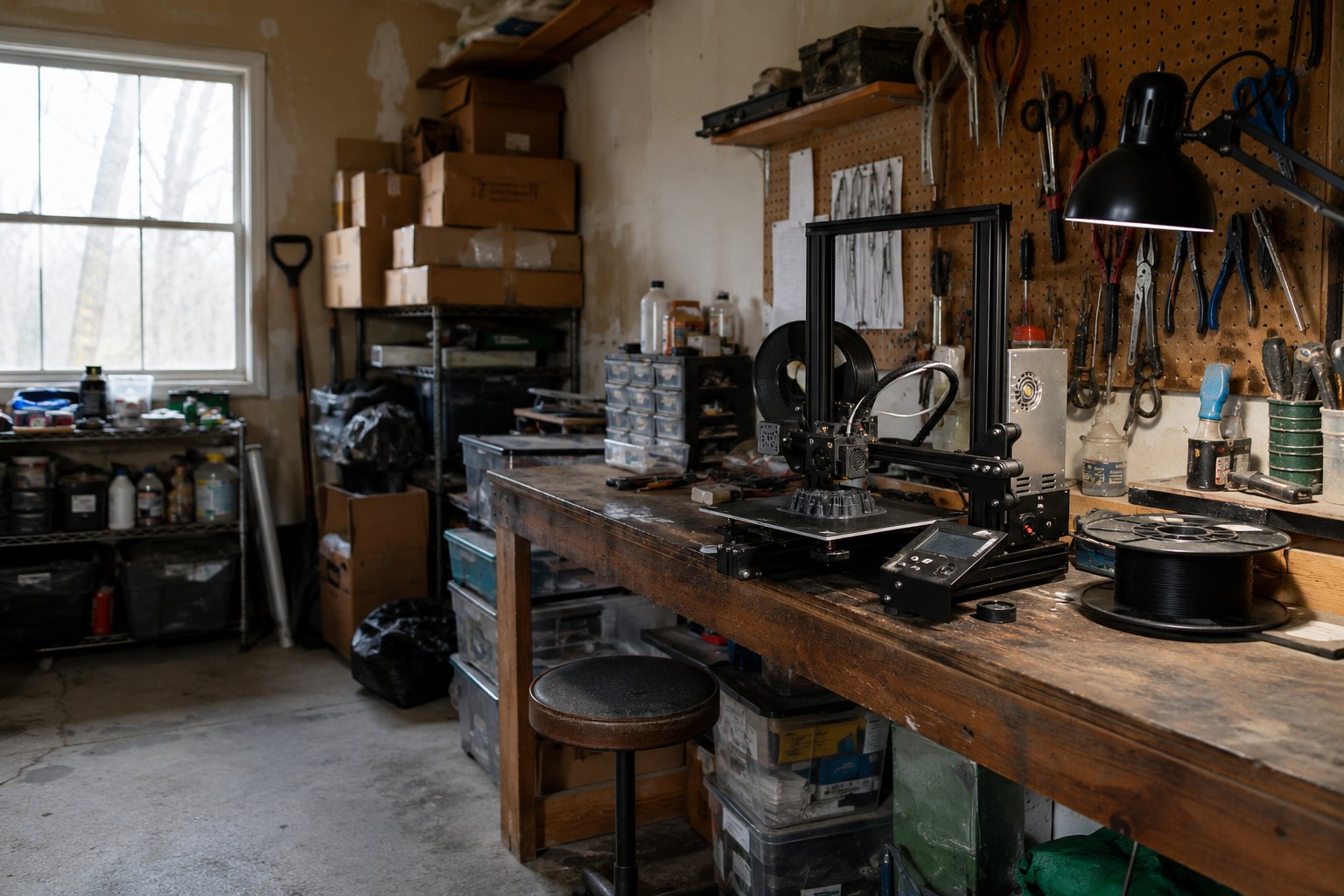
A printer hands you a part overnight for the price of the filament. It will not tell you which part is right, and that only comes from making the wrong ones.
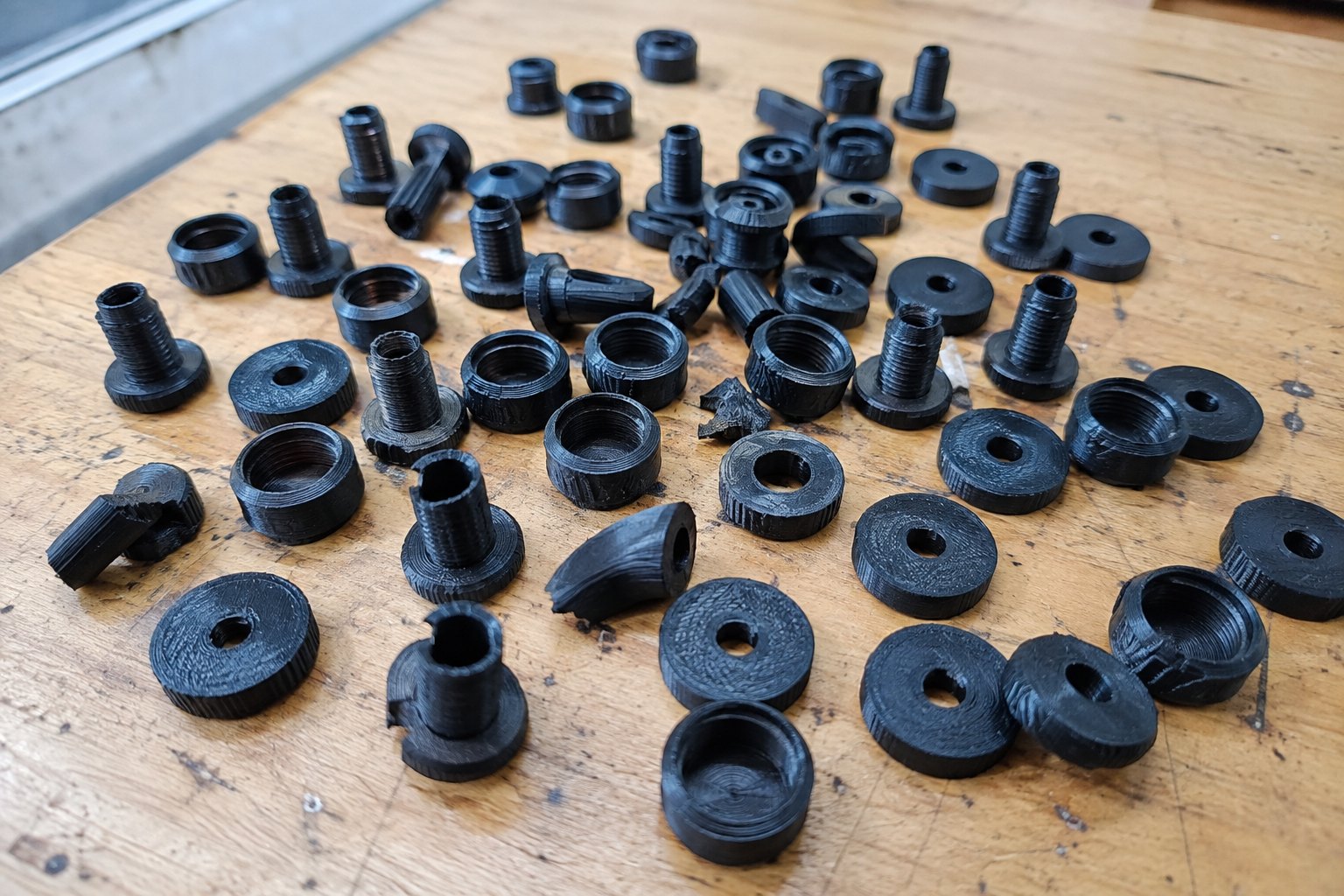
Almost all of them are wrong. That pile is the actual job, and it is the reason a screw thread that holds 140 lb without loosening took hundreds of tries rather than one.
The Engineer Who Had No Business Fixing This
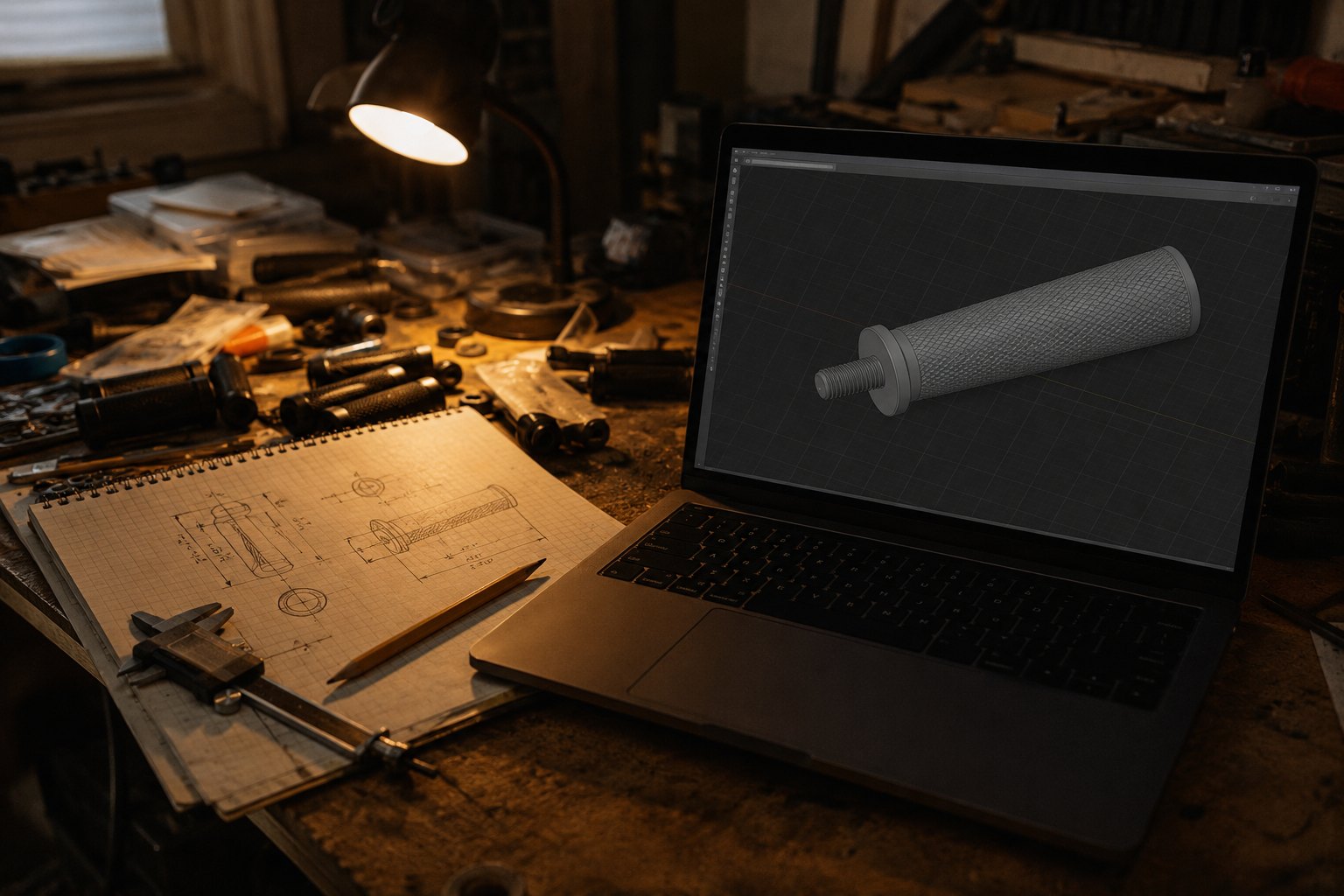
Mock holds two engineering degrees from MIT and swam at an All-American level. None of that is industrial design, so he taught himself CAD from scratch and started drawing.
The company took the name Kensui, which means pull-ups in Japanese. Its stated rule is that it only sells equipment the people who made it actually train with, which is an easy thing to claim and a slightly harder thing to build a product line around.
“Steel Is Overkill”
Here is the sentence that explains the design better than any spec sheet does.
“We often make things out of nylon, aluminum or wood that other companies make with steel. We believe steel is overkill for many items.”
Remy Mock, speaking to calisthenics.com, January 2026Most adjustable dumbbells are heavy before you put anything on them. The mechanism is the product, so the mechanism is where the money and the mass go. You pay for five to ten pounds of selector hardware you never asked for, and you pay several hundred dollars for the privilege.
His handle goes the other way. It is a knurled body with a screw thread at each end and a collar that spins down against the plates. Bare, the pair weighs about two pounds. No selector, no dock, no proprietary block, almost nothing to break.

- The weight is already in the room. Standard 28mm and 50mm plates both fit the same handle, so whatever is on your floor works and there is nothing to reorder.
- You always know the number. Plates are stamped. A tool that cannot tell you what you just lifted is a tool you cannot program around.
- The ceiling moves with you. More capacity just means more plates, which is why the top model reaches 300 lb across the pair while the empty handles still weigh about two pounds.
The Short Version
A dumbbell is a handle with weight fixed to both ends. That has been the entire idea for roughly 2,500 years, and the only real change since is that some of them now have a selector pin. What came out of that workshop ends in a screw thread instead, so you load the plates that are already on the floor.
| This handle | A selectorized dumbbell | A fixed dumbbell set | |
|---|---|---|---|
| Starting price | $49 a pair | Several hundred dollars | Four figures with a rack |
| Where the weight comes from | Plates you already own | The brand’s own block | Fixed at the factory |
| Weight of the empty tool | About 2 lb | 5 to 10 lb of mechanism | Not adjustable |
| Smallest jump | Your smallest plate | Whatever the block steps | Buy another dumbbell |
| Still useful in five years | Yes | Only with that brand’s parts | At the weights you bought |
| Learn More 4.49★ from 622 owners |
Kensui price, capacity and rating verified on the product page, August 31, 2026. The two comparison columns describe the two shapes the rest of the category comes in rather than any one competitor.
The Part That Does the Work
Bare, it looks like a bolt. That is the honest description and it is the reason people scroll past these things. Loaded, the shape disappears and it behaves like a dumbbell that happens to have no upper limit.

The $49 PRO is a reinforced polymer body rated to 140 lb across the pair, which is 70 lb in each hand. There is a $149 MAX in machined aluminium that doubles the ceiling to 300 lb, and it is out of stock as we publish this, so the PRO is the one you can actually put in a cart today.
Changing weight is slower than a selector pin and faster than most people expect. You spin off a collar, swap plates, spin it back on, then do the other hand.
“They are just the right diameter to keep an easy grip and the texture is not painful. Also I can turn these in any position while lifting and they don’t hurt the side of my hand like other brands does.”
Donald N., verified owner reviewThe Physique in the Headline
Now the photograph at the top of this page.
It belongs to Mock. His company published it, the company’s own version of this story puts a number on it, and we have measured none of that. Judge it the way you would judge any founder’s before and after, which is to say carefully.
What we can say is narrower and more useful. He built his own equipment because nothing on sale would keep getting heavier, and then he trained on it for years rather than weeks. That second part is the one nobody photographs, and a tool with no ceiling is the only kind that lets you do it.

What Everyone Else Made of It
The handles have been on sale long enough to stop being a founder’s story and start being a product other people own.

“I’ve been looking for something like this for a while. Very comfortable, perfect fit in the hand, easy to change plates.”
Daniel P., verified owner review

What $49 Actually Buys
Two handles, four collars, and access to every plate you will ever own. The tool costs less than one month of the gym membership that started this whole story, and the man who drew it did so because he could not find anything worth buying at any price.
$49 a Pair, and the Plates Are Already Yours
Two knurled handles, four collars, 140 lb across the pair, and about two pounds of tool when it is empty. Rated 4.49 stars across 622 owner reviews.
Get the AdaptaBELLSources
- Andy Toth, “Inside KENSUI Fitness with Founder Remy Mock,” calisthenics.com, January 28, 2026. Interview.
- Kensui, “Our Story,” company milestones, garage workshop to first production run, 2019. Company page.
- Price, variant capacity, stock status, owner rating and review count read from the Kensui product page on August 31, 2026. The MAX variant was out of stock at that reading.
- The room, workshop, prototype and drawing-board images in the first half of this article are illustrations, not photographs of Mock’s own workspace. Every photograph of the product itself is the manufacturer’s.
