Why Calisthenics Guys Are Obsessed With These $39 Grips


A powerlifter who hates a bar can buy a different bar. A bodyweight athlete gets whatever the city poured into the ground. That single fact explains a piece of $39 hardware that keeps falling out of backpacks at every calisthenics park in the country, and it explains the one complaint the people who own them will not say out loud.
The Guy With The Hooks
There is a rig near me that gets busy at about half six in the morning. Two pull-up bars at different heights, a set of dip bars, some monkey bars nobody uses, and a low bar for rows that is bent slightly in the middle from a decade of people doing things to it that it was not designed for. In winter the steel is cold enough that the first set hurts your hands more than your back.
I noticed the same man three mornings running because of what he did before he trained. He would put his bag down, take out two black plastic hooks, hang them over the high bar about shoulder width apart, and then do his entire session hanging from those instead of from the bar itself. Pull-ups, then hanging leg raises, then a long set of dead hangs at the end while he looked at his phone.
On the fourth morning I asked him what they were. He said they were Swissies, that he had bought them because his elbows had started clicking on high-volume pull-up days, and that he now took them everywhere. Then he said the thing that actually made me go and buy a pair: that he had gone back to a bar he used to avoid, the ice-cold one at the park by the station, because it stopped mattering what the bar was.
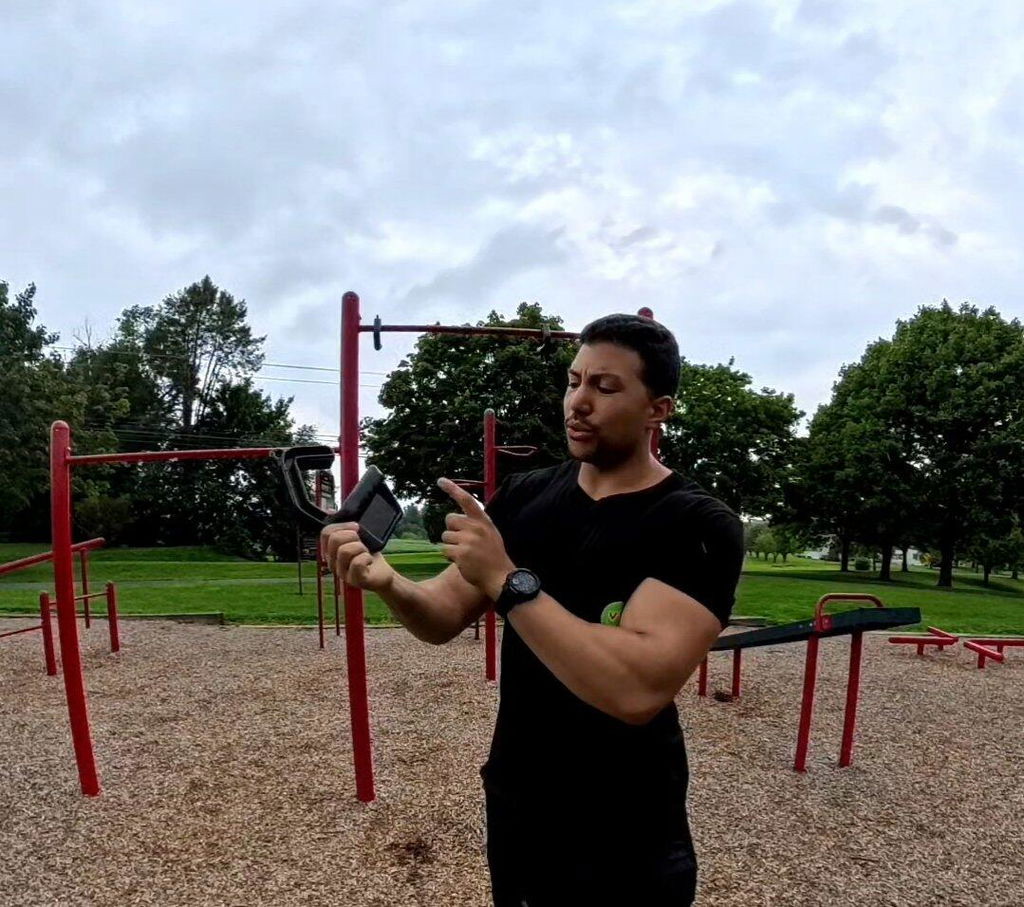

That is the part that took me a while to understand. I had been reading the appeal as a joint thing, and for plenty of people it is. But the reason this specific product spreads through calisthenics circles by word of mouth rather than through advertising has less to do with elbows and more to do with ownership. Everyone else in the gym can change the implement. Bodyweight people cannot.
The Bar Is The One Thing You Cannot Change
Think about how much choice a normal lifter has. Bar digging into your palms on rows? Use the other bar. Shoulder unhappy on flat bench? Grab dumbbells, or the cambered bar, or walk to the machine. Pressing hurts? There are four other ways to press within thirty feet.
Now do the same exercise in calisthenics. Your pull-up is a pull-up. The bar is round steel, roughly 32mm, fixed to the ground or bolted through your door frame, and it holds your hands in exactly one position: palms away, arms in a fixed plane, forearms pronated from the first rep to the last. If that position bothers you, your options are to stop, to buy a different bar you probably cannot install, or to hang rings from it.
Rings are the community's real answer, and they are a good one. They also come with conditions. You need height above the bar to hang them, which a doorway bar and most park rigs do not give you. The straps have to be set level. And unless you have somewhere to leave them, you carry them and re-rig them every session. The free rotation that makes them so good for skill work is also what makes a heavy weighted set on them feel less stable than a bar.
A pair of moulded hooks sidesteps all of that by not replacing the bar at all. They hang on it. Whatever the bar is, wherever it is, whoever else is waiting to use it after you.
The Short Version
Here is the comparison the calisthenics forums keep having, laid out properly. The honest summary: rings win outright on anything that needs rotation or ring-specific skill work, and they are the better buy if you have somewhere to hang them permanently.
| Swissies V2 $39 a pair |
Gymnastic rings | Multi-grip bar | |
|---|---|---|---|
| Works on the bar you already have | Yes hooks over it | Yes if there is height above it | No it replaces the bar |
| Set-up on an unfamiliar bar | Seconds, hang and go | Straps, height, levelling | Not portable |
| Grip width | Anywhere along the bar | Anywhere the anchors allow | Fixed by the welds |
| Goes in a backpack | Yes under a pound a pair | Yes, with straps to re-rig | No |
| Free rotation for skill work | No | Yes this is the reason to own rings | No |
| Also works on barbells, cables, bands | Yes | Bands only | No |
| Learn More |
Swissies V2 price, weight and materials verified on kensui.com on 1 September 2026. Ring and multi-grip-bar rows describe how those products work rather than a specific model, because both categories run from budget to boutique.
Volume Is The Only Progression You Have
Loaded lifters progress by adding plates. A bodyweight athlete who has run out of easy strength progresses mostly by doing more, and doing more is exactly the condition under which a fixed forearm position starts to complain.
Turning the palms to face each other is not magic and it is not a cure for anything. What it does is change which tissues take the load. Pull with palms facing away and the biceps work at a mechanical disadvantage while the forearm is held in full pronation for the duration of the set. Turn the hands in and the elbow flexors get a better line, the shoulder sits in a slightly less externally rotated position at the bottom, and the wrist is neutral rather than being held at the end of its range.
None of that makes it a better exercise. It makes it a different one, which is the whole point when the thing limiting your training is that you have been doing the identical rep for two years.

The owner reviews on the store are unusually consistent about who feels the difference. It is not beginners. The people who feel it have accumulated something.
“I bought these due to me having issue with tennis/golfer elbow on both arms and so far they’ve been great, I can finally do pull ups and other pulling exercises pain free!”
“They let me do pull ups pain free with a bad labrum tear. They are very lightweight, so they will be easy to throw in a gym bag for use out of the house.”
Treat those as what they are. They are reports from people who bought a thing and liked it, not evidence that a grip change fixes an injury. Anyone with a labrum tear or a tendinopathy should be getting that looked at rather than shopping. What the reviews do establish is the pattern: the buyers are experienced, and they are buying their way around a position rather than around a lack of strength.
Grip Width Is The Part Nobody Mentions First
Everyone talks about the palms. The thing owners bring up on their second or third purchase is width.
Because the hooks are two separate objects, you set them wherever you like along the bar and you can move them mid-session. Narrow for a set that hits more arm, wide for one that feels more like a lat pulldown, then somewhere in between when your shoulders have had enough. A fixed neutral-grip bar gives you one width, chosen by whoever welded it. Rings give you width too, but you have to re-rig for it.

“As a 53-year-old calisthenics practitioner the Swissies V2 have been a real saver for my shoulder and elbow joints. I previously used rings, but setting them up was often time-consuming. The Swissies V2 are much more convenient, you just hook them up, and that’s it.”
Max, five stars, December 2025
What $39 Actually Buys
They are moulded nylon fiberglass, not steel, which is the first thing people either accept or object to. Kensui uses the same material in the EZ-VEST PRO and the EZ-BOOT, and states the pair is tested to 800 lb. The handle is 32mm, which is the diameter of a fairly normal pull-up bar, so the grip feel is familiar rather than a fat-grip challenge.
- Price
- $39 a pair
- Material
- Nylon fiberglass
- Handle diameter
- 32mm, knurled
- Weight
- Under 1 lb a pair
- Tested load
- 800 lb
- Max bar diameter
- 50mm on the store’s V1 vs V2 chart
- Attachment
- Rubber-lined hook, plus a carabiner loop
The inside of the hook is lined with rubber pads, which is doing two jobs. It stops the handle sliding along a bar when you shift your weight, and it keeps hard plastic off the finish of a bar that may not be yours. That second one matters more than it sounds if you train at a commercial gym.

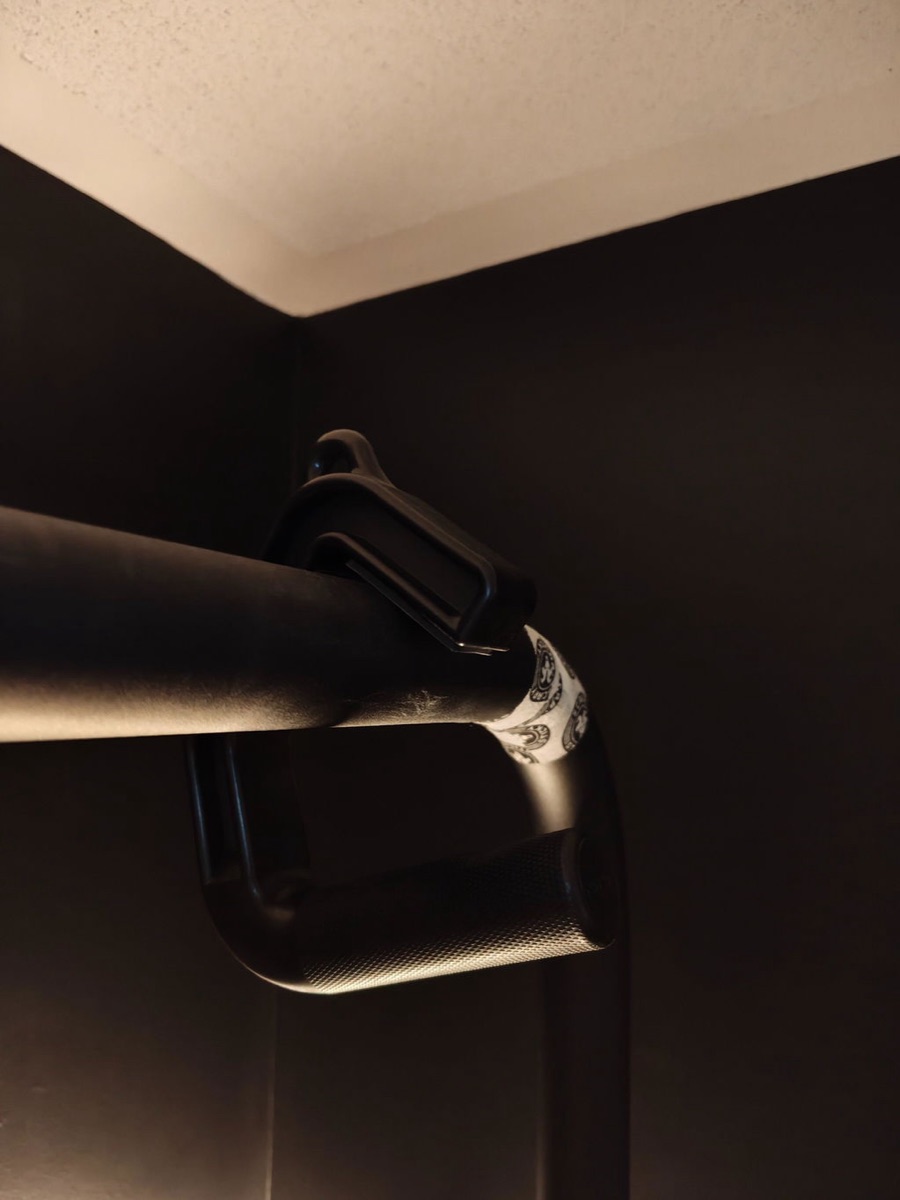
One honest note on the bar-diameter figure. The store's own V1 versus V2 comparison chart says the V2 clears bars up to 50mm, while the product copy elsewhere on the same page says up to 2.5 inches, which is 63.5mm. Those are not the same number. Measure your bar, and if it is a genuinely fat outdoor bar, treat 50mm as the figure to trust. Owners with 2-inch bars report clearance to spare.
The Backpack Test
This is the bit that makes them a calisthenics object rather than a home-gym object.
A pair weighs under a pound and stacks flat. There is no strap to wind, nothing to level, nothing to leave behind by accident. They go in the same pocket as your chalk and they come out at whatever bar you end up at, which in practice means the bar at the park, the bar at the hotel gym that is welded at the wrong width, the scaffolding pole at your parents' house.
“Great for when you are outside on the go and you come across a variety of different bars to hang on. The v2s are very sturdy and well made.”
“Love rings and used to use them all the time but my bar is too low. These are the perfect compromise.”
The carabiner loop on top is the other half of the versatility, and it is the half that pulls them out of pure bodyweight territory. Clipped to a cable stack they become a neutral-grip row handle. Looped through a band they become a band handle that does not cut into your fingers. Hooked over a straight barbell they give you something close to a trap-bar deadlift position, which is a genuinely useful trick if the only bar you own is straight.


Where They Fall Short
Four things come up repeatedly, and one of them is a real design miss.
The carabiner hole is too small
This is the miss. It appears in the lowest-rated substantive review on the product, and in two others from people who otherwise liked them. The loop moulded into the top takes the carabiners that come in the box, but it is tight enough that plenty of owners cannot clip their own bands or their gym's cable clips through it. If the cable-and-band use is the reason you are buying, this is the thing to know before you order, not after.

“Because the hole is small I can’t clip any of my bands on. Very little usefulness.”
“Well made, gentle knurling. Fairly solid. Just wish the holes for cable attachments were a little bigger.”
There is no published weight rating
The pair is described as tested to 800 lb, which is a test figure rather than a rated working load, and the store does not publish a maximum for the user plus added weight. For most people that gap is theoretical. A weighted-calisthenics athlete hanging 80 or 100 lb off a belt is asking a fair question, and at least one owner has asked it publicly without getting a number back.
$39 for plastic bothers some people
The lowest ratings that are actually about the product are about price and material rather than performance. One three-star review calls them massively overpriced for plastic hooks, and a five-star owner still writes that he wishes the next version came in steel. Both are fair positions. What you are paying for is the moulding and the two-point wedge that stops them rolling, not the raw material.
The handle is bare
The knurl is deliberately gentle, which is right for high-volume hanging and wrong if you want the aggressive bite of a knurled barbell. A couple of owners have asked for a rubber sleeve as an option. Nobody is reporting that their hands slip.
Who Should Skip These
If you have a beam, a rafter or a rig with real height above the bar, and somewhere to leave them rigged, buy rings instead. They do everything discussed here and they do rotation, muscle-up work and false-grip training on top of it. That is not a close call.
If you train only at a commercial gym that already has neutral-grip pull-up handles welded on, and you never travel, you are buying a solution to a problem you do not have.
And if you have never had a pull-up feel bad, and you are still adding reps, save the $39 and keep adding reps. This is equipment for a specific moment, which is the moment the bar itself becomes the thing standing between you and more volume.
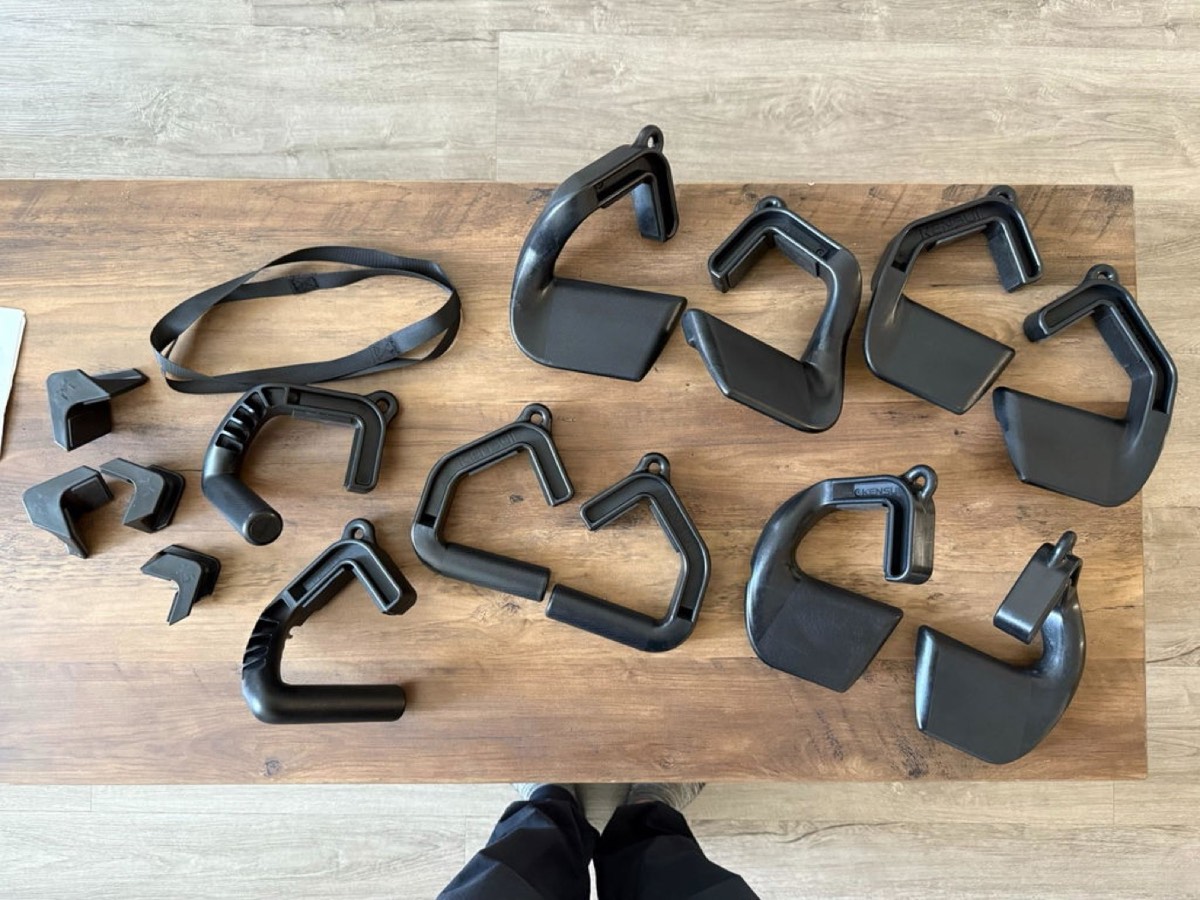
That last photo is a warning as much as anything. The line has grown a lot of variants, the store sells bundles, and a decent number of owners are now on their second or third order. If you want one thing that solves one problem, buy the one pair and stop.
One Pair, Any Bar You Meet
Under a pound in your bag, hooked over the bar in seconds, and a grip width you choose rather than one somebody welded for you. The $39 is less than most people spend on a single month of the gym membership they are trying to train around.
Get the SwissiesUp to 50mm on the store’s own V1 versus V2 chart, which covers doorway bars, most rigs and standard barbells. Fat outdoor park bars are the ones worth measuring first.
Owners do, and the pair is described as tested to 800 lb. There is no published working-load rating for user plus added weight, so if you are hanging serious plates, ask before you buy.
The inside of each hook is rubber-lined specifically to sit on a bar without scratching it. That is also what stops them sliding sideways under load.
How We Checked This
Price, stock, material, handle diameter, weight, tested load and bar-diameter figures were read off the live Kensui product page on 1 September 2026 and are quoted as the manufacturer states them. Where the page contradicts itself, on maximum bar diameter, both figures are given above rather than the more flattering one.
The rating and review count are the store’s own Judge.me figures on that date: 4.88 stars across 181 reviews, of which 166 are five-star and four are two-star or below. Quotes are taken verbatim from that review set and are attributed exactly as the store displays them. We deliberately quoted from the low ratings as well as the high ones.
Rings and multi-grip bars are compared on how the categories work rather than on a named model, because prices in both run from budget to boutique and would be out of date by the time you read this. Nothing here is medical advice, and a grip change is not a treatment for an injury.
